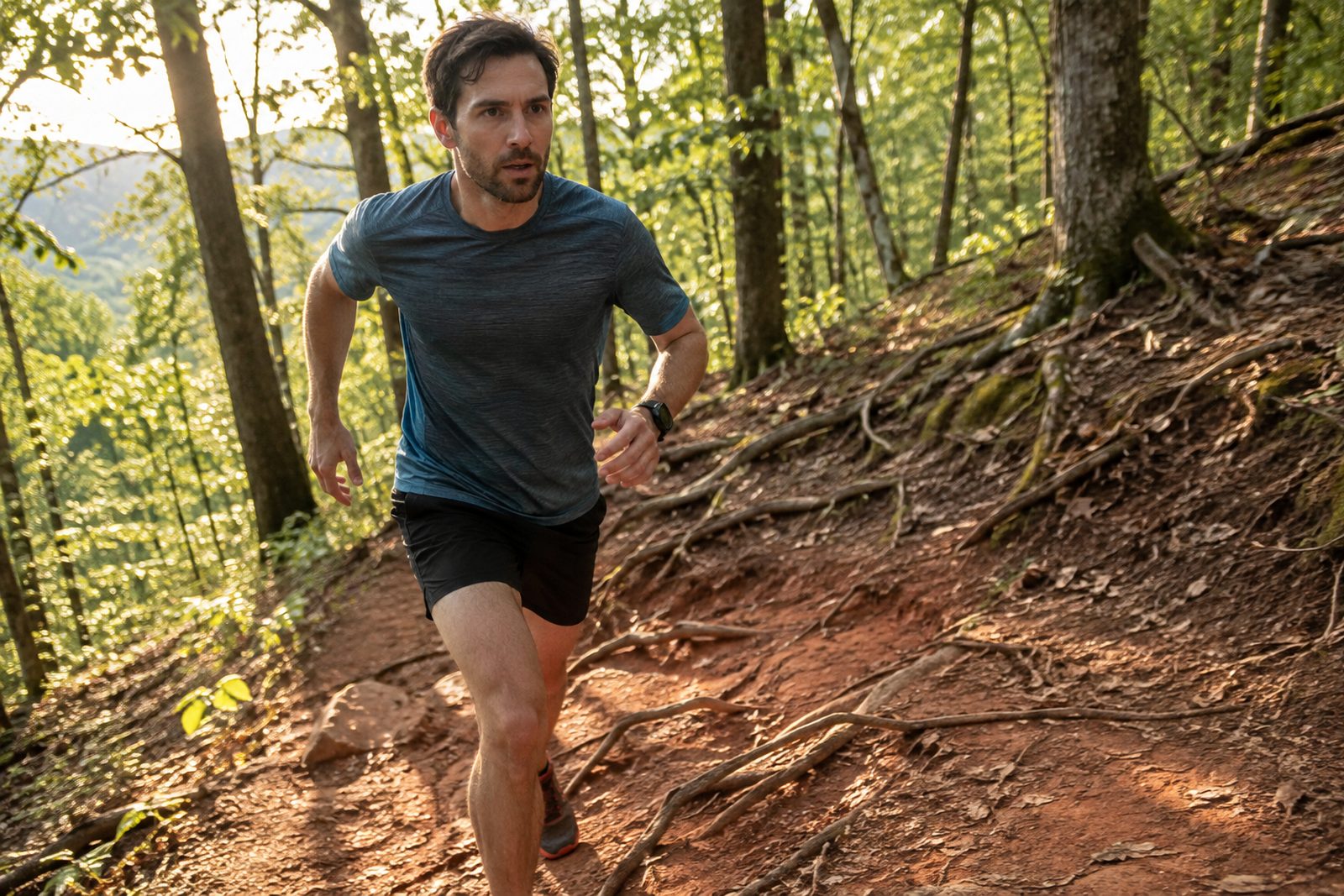
Running Kennesaw Mountain Without Wrecking Your Knees and Back
The climb up Kennesaw Mountain is a local rite of passage, and the descent is where most runners get hurt. A sports chiropractor's guide to pacing, form and recovery on steep trails.
If you run in Cobb County, sooner or later someone invites you to "do the mountain." Kennesaw Mountain National Battlefield Park has some of the steepest public trail in the metro area, and the summit climb is a favorite training run. As a former collegiate distance runner who now treats runners for a living, I love it too. I also see the aftermath: sore knees, angry IT bands and low backs that seize up the next morning. Most of it is preventable.
Why the downhill does the damage
Climbing is hard on your lungs. Descending is hard on your body. Running downhill makes your quadriceps and calves work while they lengthen, a type of contraction that creates more muscle soreness and puts more load through the knee joint and the front of the hip. On a steep, rocky descent you also tend to lean back and brake with every step, which jams force up through the heel and into the low back.
That is why so many runners finish a mountain loop feeling fine and then struggle down the stairs two days later.
Five habits that protect your knees and back
- Shorten your stride on the way down. Quick, light steps keep your feet under your hips instead of out in front of you, which cuts the braking force on every stride.
- Lean slightly with the hill, not away from it. A small forward lean from the ankles, with your eyes a few steps ahead, keeps your weight over your feet. Leaning back feels safer but loads the knees and low back more.
- Power-hike the steepest sections. Strong trail runners walk the steep climbs. Hiking uphill with your hands on your thighs saves your back and leaves your legs fresher for the descent.
- Build up the vertical gradually. If most of your miles are flat, start with one mountain loop a week and add climbing slowly. A jump in elevation is as risky as a jump in mileage.
- Train the muscles that brake. Two short sessions a week of step-downs, split squats, single-leg bridges and calf raises make the descent far less punishing.
Shoes, surfaces and the day after
A trail shoe with decent grip helps you trust your footing, which lets you relax and run more naturally on the way down. You do not need maximum cushioning; you need traction and a fit that keeps your foot from sliding forward on descents.
The day after a hard mountain run, plan an easy recovery jog or walk on flat ground, not total rest. Gentle movement clears soreness faster than sitting still. Sleep and protein matter more than any gadget.
Pain that is a warning, not just soreness
General muscle soreness that peaks a day or two after a run and fades by day four is normal. These are not normal, and are worth getting checked:
- Sharp pain on the outside of the knee that starts at the same point in every run (a common sign of IT band irritation)
- Pain at the front of the knee going downstairs that lingers for more than a week
- Low back pain that travels into the buttock or leg, or comes with tingling or numbness
- Pain in one specific spot on a bone that hurts to press, which can signal a stress injury
- Swelling, locking or a knee that gives way
Our free movement screen is a quick way to spot the hip and ankle limitations that often sit behind these problems.
How we help runners
When a runner comes to see me, we start with how the injury happened and then watch you move: a squat, a single-leg balance, a step-down and, when it helps, a look at your running form. Treatment usually combines adjustments where joints are restricted, soft-tissue work for tight or overworked muscles, and a short exercise plan you can do at home. Our goal is to keep you running while you heal whenever that is safe, and to get you back on the mountain with a plan that keeps the problem from returning.
If the mountain has been unkind to your knees or back, book a visit or call (770) 555-1234. And if you are new to running, come find our free Saturday beginner group. We will save you a spot at the back.
Conditions covered here

Knee Pain & Osteoarthritis
Arthritis on the scan is not a life sentence.

IT Band Syndrome
Knee pain from a band that runs down the thigh.

Lower Back Pain
The most common reason people stop doing things.

Acute Sports Injuries
The first seventy-two hours change the timeline.

Plantar Fasciitis & Heel Pain
The first ten steps of the morning are the tell.
Treatments and equipment mentioned

Sports Chiropractic & Athletic Performance
Built for the recreational athlete who is not done.

Running & Gait Analysis
Your running form, measured rather than described.

Active Rehab & Corrective Exercise
The part that decides whether it comes back.

Foot & Gait Pressure Scanning
Every step you take, mapped as pressure.
Most new patients are seen the day they call, and Saturday mornings are open for anyone who cannot get away during the week. Call (770) 555‑1234 and the front desk will find you the first opening.
Call (770) 555‑1234 →Find out what is actually going on
LeadWorks Chiropractic in Kennesaw, Georgia — an examination that ends with an explanation and a plan you can read.